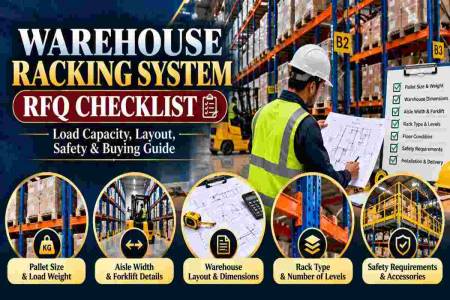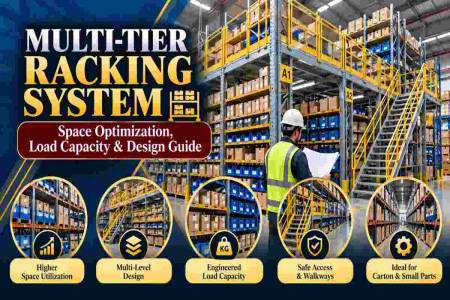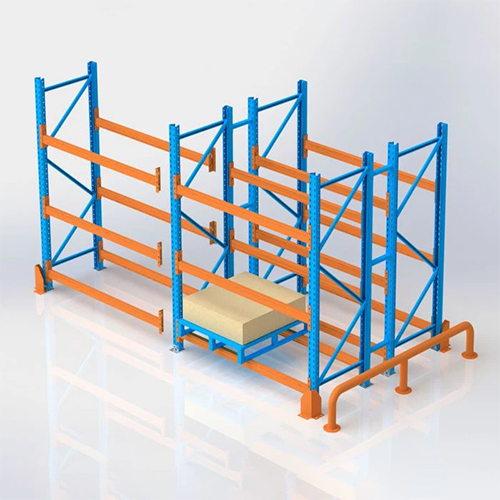
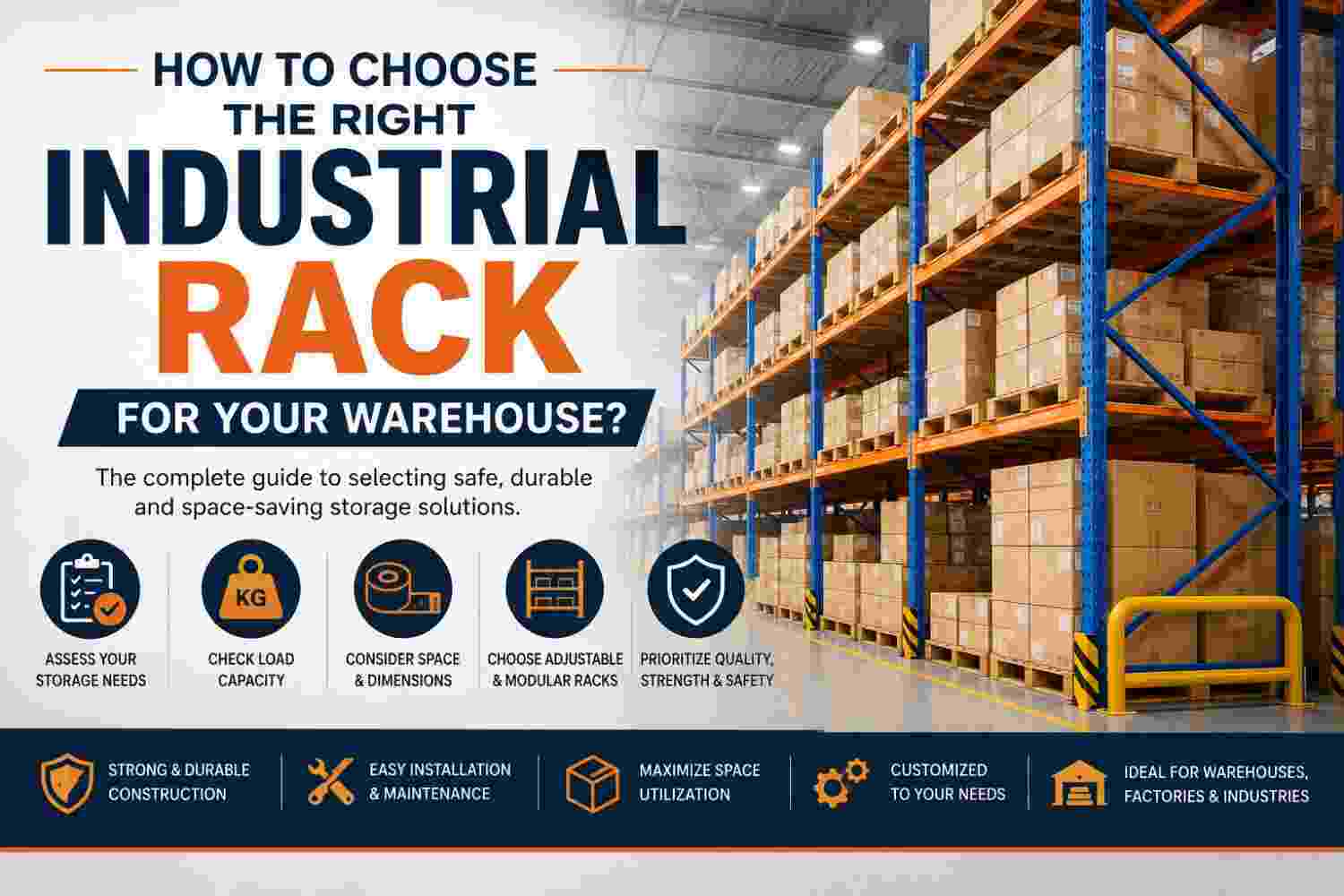
The right industrial rack should be selected based on load capacity, available floor space, storage type, rack dimensions, accessibility, adjustability, and future storage requirements. Choosing a rack only by its size or price can lead to inefficient space usage or a system that does not properly support your inventory.
Warehouses, factories, workshops, and commercial storage areas often handle different types of goods. Some need to store heavy equipment, while others deal with boxes, components, tools, raw materials, or bulk inventory.
A properly selected storage system can make products easier to organize, improve accessibility, and make better use of available space.
How Do You Choose the Right Industrial Rack?
Start by identifying what you need to store, how much each load weighs, how frequently items are accessed, and how much space is available.
Before selecting a rack, evaluate:
- Type of goods being stored
- Weight per shelf or level
- Number of storage levels required
- Available floor and ceiling space
- Required rack dimensions
- Frequency of material handling
- Need for adjustable shelves
- Future expansion plans
- Environmental conditions
- Maintenance requirements
A warehouse storing heavy machinery components will have different requirements from one storing lightweight cartons or small parts.
What Type of Rack Is Best for a Warehouse?
The best rack depends on the type, weight, size, and volume of goods being stored.
Different storage applications may require different rack configurations.
For example:
- Heavy goods may require heavy-duty storage systems.
- Small components may work better with shelving-style racks.
- Long materials may require specialized support.
- Palletized goods may need pallet racking.
- Frequently changing inventory can benefit from adjustable configurations.
- Bulk materials may require racks designed for higher capacities.
The goal is to select a system that matches the actual storage process rather than choosing a rack based only on appearance.
How Much Load Should an Industrial Rack Hold?
The rack's load capacity should be greater than the maximum weight you intend to store, with the manufacturer's specified capacity followed for safe operation.
Before ordering, determine the maximum expected load per level.
Consider:
- Weight of individual items
- Number of items per shelf
- Total load per level
- Number of levels
- Distribution of weight
- Frequency of loading and unloading
The product page lists customized load capacities for several rack configurations, showing that requirements can vary according to the application.
Never assume that two racks with similar dimensions have the same load capacity.
Why Is Adjustable Racking Important for Warehouses?
Adjustable racks allow storage levels to be changed according to the size of the products being stored.
Warehouse inventory can change over time. One month, a business may need space for smaller cartons, while later it may need taller storage areas.
Adjustable configurations can help accommodate:
- Different box sizes
- Changing inventory
- Different product heights
- Seasonal stock
- New product lines
The industrial rack page specifically highlights adjustable shelves and modularity as features intended to accommodate changing storage needs.
How Can Industrial Racks Improve Warehouse Space Utilization?
Industrial racks improve space utilization by using vertical storage instead of relying only on floor space.
Without an organized racking system, inventory can spread across the warehouse floor, reducing available working space.
A well-planned rack layout can help you:
- Use vertical height
- Keep aisles organized
- Separate different product categories
- Improve product visibility
- Reduce unnecessary floor congestion
- Create more systematic storage zones
However, rack height should always be compatible with the building, handling equipment, access requirements, and safety considerations.
Should You Choose Fixed or Modular Storage Racks?
Modular racks can be a better option when your storage requirements are likely to change over time, while fixed configurations may work well when storage needs are stable.
A modular approach can make it easier to adapt the storage arrangement as inventory changes.
Consider a modular system if:
- Product dimensions frequently change.
- Inventory levels fluctuate.
- The business is expanding.
- Additional storage levels may be required.
- The warehouse layout may change.
For stable inventory and fixed requirements, a simpler configuration may be sufficient.
What Material Is Best for Heavy-Duty Storage Racks?
Steel is commonly used for industrial storage racks because it can provide the structural strength needed for demanding storage applications.
The industrial rack range on the referenced page includes steel and mild-steel configurations, with different rack products offering customized sizes and capacities.
Material selection should consider:
- Expected load
- Rack dimensions
- Operating environment
- Surface treatment
- Required durability
- Maintenance requirements
The exact material specification should be confirmed according to the intended application.
How Does Powder Coating Protect Industrial Racks?
Powder coating provides a protective surface finish that can help improve resistance to everyday wear and environmental exposure.
The referenced industrial rack range includes powder-coated products and other surface treatments.
A suitable coating can help protect the rack surface from:
- Scratches
- General wear
- Moisture exposure
- Surface deterioration
However, the appropriate surface treatment depends on the warehouse environment and the material being stored.
Are Industrial Racks Suitable for Factories and Warehouses?
Yes, industrial racks can be used in factories and warehouses for organized storage of materials, tools, equipment, components, cartons, and other inventory.
They can also be used in:
- Workshops
- Manufacturing units
- Distribution centers
- Godowns
- Commercial storage areas
- Industrial facilities
The correct rack configuration should be selected based on the type of inventory and handling process.
How Do You Choose Rack Dimensions?
Rack dimensions should be based on the available space and the dimensions of the products being stored.
Measure:
- Available floor area
- Ceiling height
- Aisle width
- Product length
- Product width
- Product height
- Required clearance
Do not select the rack first and then attempt to adjust the warehouse around it.
Instead, plan the storage layout first and determine how the racks will fit into the available space.
Why Is Aisle Space Important When Installing Racks?
Aisle space is important because workers and material-handling equipment need sufficient room to access stored products safely and efficiently.
When planning rack placement, consider:
- Forklift movement
- Trolley movement
- Manual picking
- Emergency access
- Loading and unloading
- Product handling
Installing too many racks without sufficient working space can reduce operational efficiency.
More racks do not automatically mean better storage.
How Do You Choose a Rack Based on Product Size?
Select the rack configuration according to the dimensions and shape of the products rather than only their weight.
For example, long products may require a different storage solution from small boxes.
Consider:
- Product length
- Product width
- Product height
- Shape
- Weight
- Packaging
- Accessibility
Leaving appropriate clearance around products can also make loading and retrieval easier.
What Is the Difference Between Load Capacity and Storage Capacity?
Load capacity refers to how much weight a rack or level can safely support, while storage capacity refers more broadly to how much inventory the system can accommodate.
A rack may have several levels and therefore provide substantial total storage space, but each level still has its own load limitations.
When planning a warehouse, calculate both:
- Weight requirements
- Physical storage requirements
This helps prevent situations where a rack has enough space but insufficient capacity for the intended goods.
How Can Adjustable Shelves Help With Changing Inventory?
Adjustable shelves allow storage levels to be repositioned when product dimensions or inventory requirements change.
This can be particularly useful for businesses with:
- Multiple product sizes
- Seasonal inventory
- Frequently changing stock
- Different packaging dimensions
- Growing product ranges
Instead of replacing the entire rack system, the storage arrangement can potentially be adapted to the new requirements.
When Should You Choose Customized Storage Racks?
Customized racks are worth considering when standard dimensions or capacities do not suit your warehouse layout or inventory.
Customization can be useful when you have:
- Unusual product dimensions
- Limited floor space
- Specific height requirements
- Special load requirements
- Unique storage layouts
- Specific number of levels
- Particular color or finish requirements
The referenced page states that customized racks are available according to customer requirements.
Before requesting customization, provide accurate measurements and load information to the manufacturer.
Are Industrial Racks Suitable for Small Warehouses?
Yes, industrial racks can be useful in smaller warehouses when the system is planned around available floor and vertical space.
For smaller facilities, space planning becomes particularly important.
You may need to consider:
- Rack height
- Aisle width
- Access points
- Door locations
- Ceiling clearance
- Product movement
- Future expansion
A compact but well-planned storage layout can provide more usable capacity without unnecessarily blocking working areas.
How Do Industrial Racks Help Organize Inventory?
Industrial racks create defined storage locations that can make products easier to identify, access, and manage.
Instead of placing inventory randomly across the floor, products can be organized by:
- Product category
- SKU
- Size
- Weight
- Frequency of use
- Department
- Production stage
Clear organization can also make stock counting and retrieval more efficient.
What Should You Consider for Heavy Goods?
Heavy goods require racks specifically designed and rated for the expected load and dimensions.
Before storing heavy materials, check:
- Maximum load per level
- Total rack capacity
- Load distribution
- Shelf or beam design
- Rack dimensions
- Floor condition
- Handling equipment
Never exceed the manufacturer's stated capacity.
Heavy items should also be positioned appropriately within the storage system to maintain stable operation.
How Important Is Rack Stability?
Rack stability is essential because storage systems must remain secure while goods are loaded, unloaded, and accessed.
Stability depends on factors such as:
- Proper installation
- Suitable dimensions
- Load distribution
- Correct anchoring where required
- Level flooring
- Appropriate use
- Regular inspection
The rack should be installed according to the manufacturer's recommendations and used within its specified limits.
How Do You Maintain Industrial Racks for Long-Term Use?
Regular inspection and timely maintenance can help identify damage before it becomes a larger operational problem.
A basic maintenance routine can include:
- Checking for bent components
- Inspecting joints and connections
- Checking bolts and fasteners
- Looking for corrosion
- Checking shelves or beams
- Ensuring loads are properly distributed
- Repairing damaged components promptly
The referenced page also recommends routine inspections for damage, loose nuts, bolts, and signs of wear.
How Often Should Warehouse Racks Be Inspected?
Racks should be inspected regularly, with inspection frequency based on usage, environment, load conditions, and the manufacturer's recommendations.
A visual check can help identify obvious problems such as:
- Bent frames
- Damaged shelves
- Loose connections
- Corrosion
- Impact damage
- Uneven loading
Any serious damage should be addressed promptly rather than continuing to use the affected section.
Can Industrial Racks Be Expanded Later?
Some modular storage systems can be expanded or reconfigured when additional storage is required, provided the system is designed for such changes.
This is one reason businesses should consider future requirements before selecting a rack.
Ask:
- Can additional levels be added?
- Can the layout be changed?
- Are compatible components available?
- Can the rack capacity support future modifications?
- Will expansion affect aisle space?
Planning for growth can reduce the need for a complete storage-system replacement later.
How Do You Choose Racks for a Growing Business?
Choose a storage system that can accommodate current requirements while allowing reasonable flexibility for future inventory growth.
A growing business should consider:
- Current stock levels
- Expected inventory growth
- Product range expansion
- Available warehouse height
- Future floor-space requirements
- Modular configurations
- Additional rack compatibility
A slightly more flexible system can sometimes provide better long-term value than a system designed only for today's inventory.
What Should You Check Before Buying Industrial Racks?
Before purchasing, verify the rack's material, dimensions, load capacity, configuration, surface finish, installation requirements, and customization options.
Ask the supplier about:
- Maximum load per level
- Total capacity
- Rack dimensions
- Number of shelves or levels
- Material specification
- Surface treatment
- Installation
- Customization
- Delivery
- Maintenance support
The referenced product range includes customized dimensions, capacities, surface treatments, and configurations across several rack models.
Is the Cheapest Industrial Rack Always the Best Choice?
No, the lowest initial price does not necessarily represent the best value for a warehouse.
A storage system should be evaluated based on:
- Load capacity
- Construction quality
- Expected service life
- Flexibility
- Surface finish
- Installation
- Maintenance
- Customization
- Supplier support
A rack that costs slightly more but better matches your operational requirements may provide greater long-term value.
Why Is Professional Rack Planning Important?
Proper planning helps ensure that the rack configuration matches the available space, inventory, load requirements, and workflow.
Before installation, consider creating a layout that shows:
- Rack locations
- Aisles
- Loading areas
- Workstations
- Doors
- Material movement
- Emergency access
This can help identify layout problems before the racks are installed.
What Is the Best Storage Solution for a Warehouse?
The best storage solution is one that safely accommodates your inventory while using available space efficiently and allowing convenient access to products.
There is no universal rack configuration for every warehouse.
A suitable system depends on:
- Product type
- Product weight
- Inventory volume
- Warehouse dimensions
- Access frequency
- Handling equipment
- Future growth
For businesses looking for industrial storage solutions for warehouses, choosing the rack according to these practical factors can make storage more organized and adaptable.
Final Thoughts
Choosing an industrial rack is ultimately a storage-planning decision, not simply a product purchase.
Start by understanding what you need to store, how heavy the goods are, how frequently they are accessed, and how much space is available. Then consider rack dimensions, configuration, adjustability, material, surface treatment, and future expansion.
For warehouses and factories, the right storage system can help organize inventory, use vertical space more effectively, and make everyday material handling more convenient.
Before placing an order, confirm the load capacity, dimensions, material, configuration, installation requirements, and customization options with the supplier. Samples or technical specifications can also help when the project has specific requirements.
For businesses searching for industrial storage solutions for warehouses, selecting a system around the actual workflow and inventory requirements is the most practical way to create a reliable and efficient storage environment.