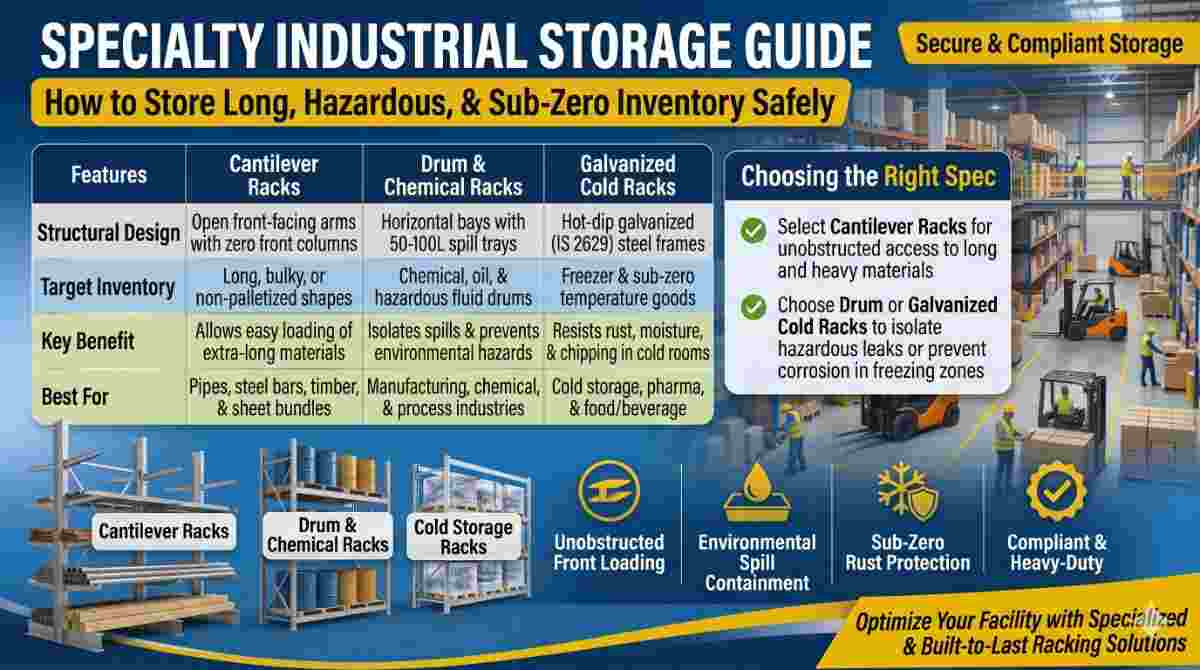
Why do pipes, steel bars, timber, and sheet bundles require cantilever racks instead of standard pallet bays?
Pipes, steel bars, timber, and sheet bundles require cantilever racks because their long, awkward, or non-palletized shapes will not fit inside standard rack bays with front columns. Cantilever racks use single or double-sided columns with open, front-facing arms and zero obstruction from front uprights, allowing forklifts or cranes to load and retrieve extra-long materials from the front without maneuvering around vertical obstructions.
Attempting to store long industrial items in standard pallet racking creates dangerous overhanging loads and slows down picking times. When sourcing specialized racking from Spanco Storage Systems, selecting a heavy-duty cantilever rack (handling up to 1,000 kg per arm) keeps your bulky inventory secure, organized, and easily accessible.
How do drum storage racks with 50–100 liter spill trays prevent chemical leaks and safety violations?
Drum storage racks prevent hazardous chemical leaks and environmental safety violations by storing 50 to 100-liter drums horizontally on secure cradles over a dedicated steel containment spill tray, which catches any drips, leaks, or accidental spills directly below the bay before they can reach the warehouse floor. This setup meets safety and environmental compliance standards while keeping your floor clean and non-slippery.
Storing chemical and industrial drums on standard shelves without containment poses a major environmental and slip hazard. Installing specialized drum storage racks with integrated spill trays isolates leaks right at the bay, while combining them with chemical-resistant industrial storage racks ensures safe, sturdy containment for a variety of fluid containers.
Why do cold storage and freezer warehouses require galvanized racks instead of standard powder-coated steel?
Cold storage and freezer warehouses require hot-dip galvanized steel racks because sub-zero temperatures (ranging down to -30°C) combined with high humidity and frequent washdowns create a highly corrosive environment where standard powder-coated steel will rapidly chip, rust, and fail. Hot-dip galvanization (conforming to IS 2629) provides a thick, metallurgically bonded zinc barrier that protects the interior and exterior of the steel from rust and moisture, even under intense thermal cycles.
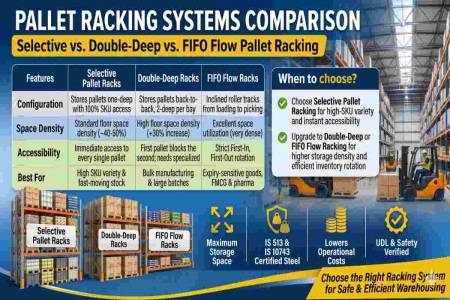
Using standard powder-coated steel in freezing, high-moisture zones will quickly lead to rust and structural issues. Specifying galvanized cold storage racks preserves load capacity, ensures sanitary operations, and extends the lifespan of the racking. For high-density freezing applications, pairing these galvanized frames with selective pallet racks or drive-in systems allows you to make the most of every cubic meter of refrigerated space.
How should plant buyers specify arm loads, cradle types, and corrosion finishes for custom specialty racks?
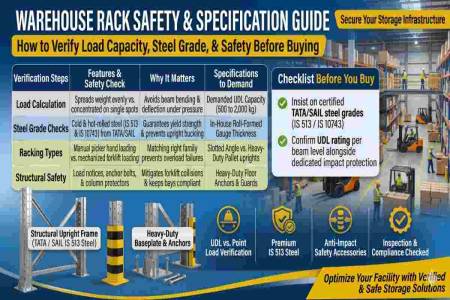
Plant buyers should specify the exact material length, maximum bundle or drum weight (uniformly distributed load, or UDL), the required arm or shelf depth, loading method (by hand, forklift, or crane), and the environmental conditions (such as moisture, temperature, or chemical exposure). For long loads, specify whether you need single or double-sided cantilever columns with optional arm end-stops; for liquid storage, include cradle types and containment capacity; and for corrosive environments, choose either hot-dip galvanized or chemical-resistant powder finishes.
Incorrect specifications can result in overloaded components or quick material wear. Procurement teams can review sizing checklists and load capacity guidelines on the Spanco Storage Systems blog to verify arm-to-column calculations and safety factor requirements. When you are ready to design a specialized storage setup, you can request a custom engineering quote with your dimensions and batch requirements to get started.